For years, software engineering followed a fairly predictable path: learn a programming language, build projects, get a job, gain experience, and eventually become a senior engineer. It was never easy, but the trajectory felt visible and well-defined.
Then AI arrived—not gradually, and not politely. Within months, it fundamentally shifted the velocity of the entire industry. Today, AI can scaffold applications, generate APIs, write tests, refactor legacy systems, design interfaces, review pull requests, generate documentation, and even deploy cloud infrastructure.
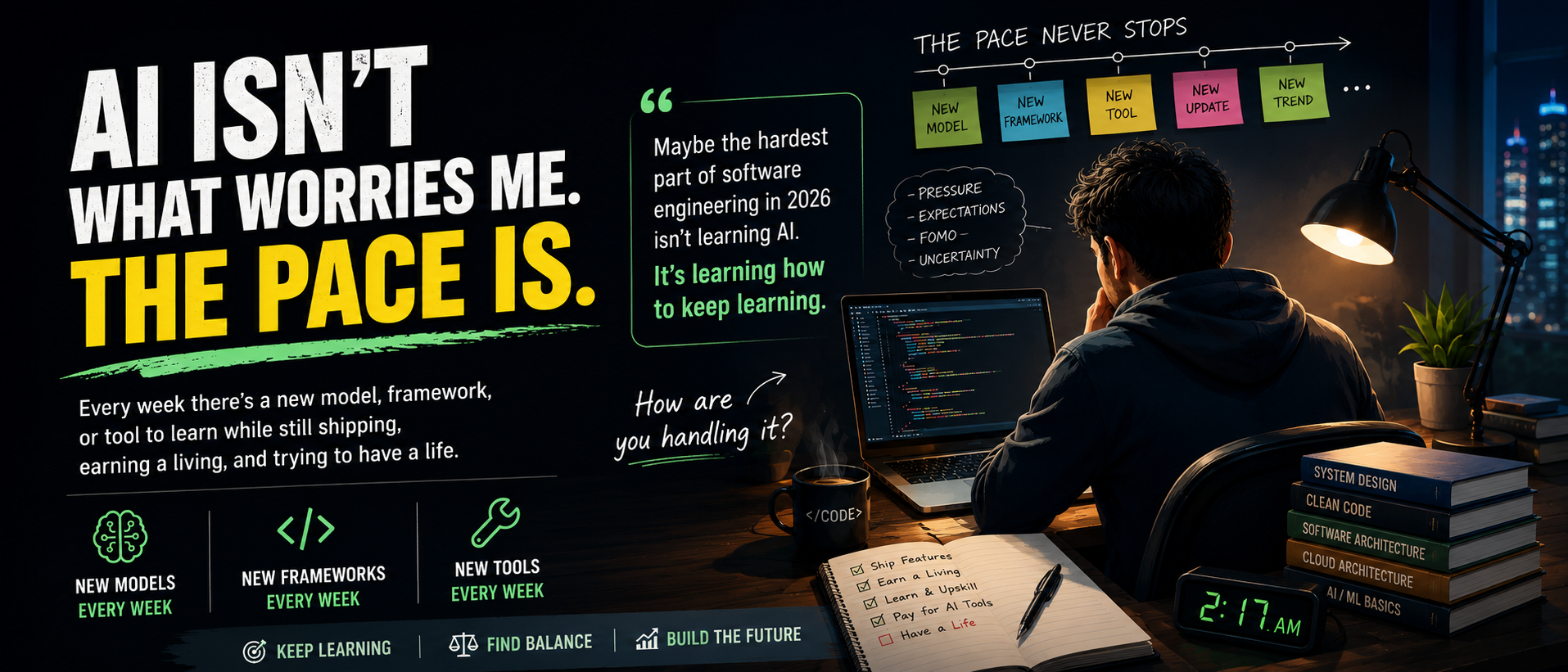
Every week another model appears, every month another workflow changes, and every quarter another company claims that software development has been permanently reinvented. The expectations shifted almost overnight. But something else changed too—something nobody talks about: what it actually feels like to be the developer trying to navigate inside this new reality.
"Learn the Fundamentals"
This is probably the most common advice you'll hear today, and honestly, it's solid advice. Core engineering principles will outlive today's AI models:
- Data Structures & Algorithms
- Databases & Query Optimization
- Networking & Protocols
- Operating Systems & Kernel Basics
- Security & Threat Modeling
- System Design & Distributed Systems
- Concurrency & Multithreading
These concepts remain timeless. But here is the question nobody seems to answer:
How do you stay motivated to master all of that while simultaneously trying to keep your job, ship production features, support your family, and pay for the AI tools you're expected to use?
The learning scope has exploded. A few years ago, mastering one backend framework was enough to build a solid career. Today, developers are expected to understand:
- Cloud platforms (AWS, GCP, Azure)
- Containerization (Docker, Kubernetes)
- Modern CI/CD pipelines
- AI coding assistants & agentic workflows
- RAG, MCP, and Vector Databases
- Multiple LLM APIs, embeddings, and prompt engineering
- Security, observability, and performance profiling
- Both frontend and backend ecosystem shifts
...and whatever new paradigm launches next Tuesday. The problem isn't that learning is difficult—the problem is that the finish line keeps moving.
Businesses Don't Buy Architecture
This realization took me a long time to grasp. As engineers, we love discussing architectural elegance: Should we use microservices or monoliths? Redis or Memcached? Event sourcing? Kubernetes or a simple VPS? Horizontal auto-scaling or distributed caching?
To us, these discussions matter—they are part of our craft. But most business owners don't wake up thinking about Redis cluster topologies. They wake up thinking about:
- Revenue & Unit Economics
- Customer Acquisition & Retention
- Growth & Market Speed
- Margins & Profitability
If the application works and solves a user problem, they are happy. If AI built 80% of the codebase, they are still happy. If you spent three weeks designing immaculate software architecture that doesn't immediately move business metrics, most stakeholders won't even notice.
Businesses don't buy architecture. They buy outcomes. That isn't wrong—it's simply how commerce operates.
Until Everything Breaks
Then, everything changes.
Traffic suddenly spikes. The primary database locks. Payment gateways start timing out. Memory usage steadily climbs. Background job queues stall, and concurrency edge-cases begin exposing race conditions in production. The server crashes.
Suddenly, everyone is asking the real questions:
Why is the system down? Can we fix it right now? How long until customers can transact again?
This is where software engineering quietly becomes visible. Nobody notices resilient infrastructure; everybody notices broken infrastructure. The true value of engineering isn't measured by what people see on the surface—it is measured by the disasters they never experience.
AI Accelerated Expectations, Not Just Code
If AI can build an MVP in a single day, managers ask why a new feature needs a week. If another startup launched yesterday, stakeholders ask why your team can't ship tomorrow.
The uncomfortable truth is that AI accelerated industry expectations just as much as it accelerated individual productivity.
Writing code was never the hardest part of software engineering. The real challenge has always been:
- Understanding ambiguous requirements
- Reviewing and auditing generated code for hidden flaws
- Designing maintainable, loosely-coupled systems
- Preventing and diagnosing production outages
- Architecting software that survives years of iteration
The tools got faster, but the ultimate responsibility didn't change.
The Invisible Cost of Staying Relevant
People often claim AI is making software development cheaper. That may be true for organizations, but for individual developers, the cost of staying relevant has grown significantly.
Many engineers now personally pay monthly subscriptions for:
- ChatGPT Plus / Claude Pro / Gemini Advanced
- Cursor / GitHub Copilot
- OpenRouter & LLM API Credits
- Cloud GPU instances & dev tooling
Ironically, developers are spending their own money just to maintain the baseline productivity expected by the companies employing them. Learn faster, ship faster, spend more, repeat.
The Fear Nobody Admits
I don't think most developers are afraid of AI taking their jobs. I think they are afraid of becoming irrelevant.
They are afraid the specialized skills they spent years mastering might depreciate. They are afraid they'll never catch up because every single week brings another model, another framework, another workflow, and another "must-learn" tool.
The underlying fear isn't about AI—it's about the relentless, unsustainable pace.
Measuring Engineering Value Differently
For decades, developers were implicitly evaluated by the volume of code they wrote. Now that AI can generate thousands of lines in seconds, code volume is no longer a meaningful metric.
The real value of a software engineer has shifted toward:
- Navigating system complexity
- Making sound architectural trade-offs
- Recognizing when AI output is flawed or unsafe
- Designing resilient systems that survive real-world load
- Translating business ambiguity into reliable execution
Code is becoming cheap. Engineering judgment is becoming invaluable.
The Balancing Act Nobody Teaches
Every day feels like an unspoken negotiation:
- Should I spend two hours learning the latest AI workflow, or build something that generates revenue?
- Should I invest in long-term computer science principles, or optimize for what hiring managers want today?
- Should I become exceptionally deep in one domain, or stay broad across modern stacks?
There is no textbook answer. We are balancing multiple roles simultaneously: developer, student, researcher, product builder, and system architect. And we are expected to continuously evolve while supporting our lives.
Learning to Adapt Without Losing Yourself
Maybe success today isn't about knowing every framework, model, or AI tool—that is physically impossible.
Perhaps success today means learning fast enough to adapt without burning out in the process:
- Choosing depth where it truly matters
- Using AI as a force multiplier rather than competing against it
- Accepting that nobody knows everything in an era of exponential change
Final Thoughts
This isn't another article debating whether AI will replace programmers. The real questions are far more personal:
- How do we sustain continuous learning without burning out?
- How do we build meaningful, long-term careers in an industry undergoing constant disruption?
- How do we keep our curiosity and passion for crafting software alive?
I don't have all the answers—I am navigating this transition alongside everyone else. But perhaps this is the honest conversation we should be having: not just about what AI can generate, but about how engineers can build resilient careers and fulfilling lives in a world that refuses to stand still.
References
- McKinsey & Company — The AI Revolution in Software Development (Read Insight)
- McKinsey & Company — Unlocking the Value of AI in Software Development (Read Insight)
- McKinsey & Company — AI-Powered Software Development: How Technology is Rewriting the Rules (Read Insight)
- McKinsey & Company — How an AI-Enabled Software Product Development Life Cycle Will Fuel Innovation (Read Insight)
- Abhik Roychoudhury et al. — AI Software Engineer: Programming with Trust (arXiv, 2025) (Read Paper)
- Ilya Zakharov et al. — AI in Software Engineering: Perceived Roles and Their Impact on Adoption (arXiv, 2025) (Read Paper)
- TechRadar — Humans in the Loop: How Software Teams Are Learning to Trust AI (Read Article)
Author's Note
This reflection isn't an argument for or against AI—it's simply a candid perspective from an engineer navigating an industry moving at breakneck speed. If you've felt the same pressure, uncertainty, or curiosity, I'd love to hear your thoughts. None of us have all the answers yet, and that's okay.